Windows VPN: How to Set It Up and Choose the Right Option

Learn what Windows’ built-in VPN settings do, how to connect, and when to use a VPN provider’s app.
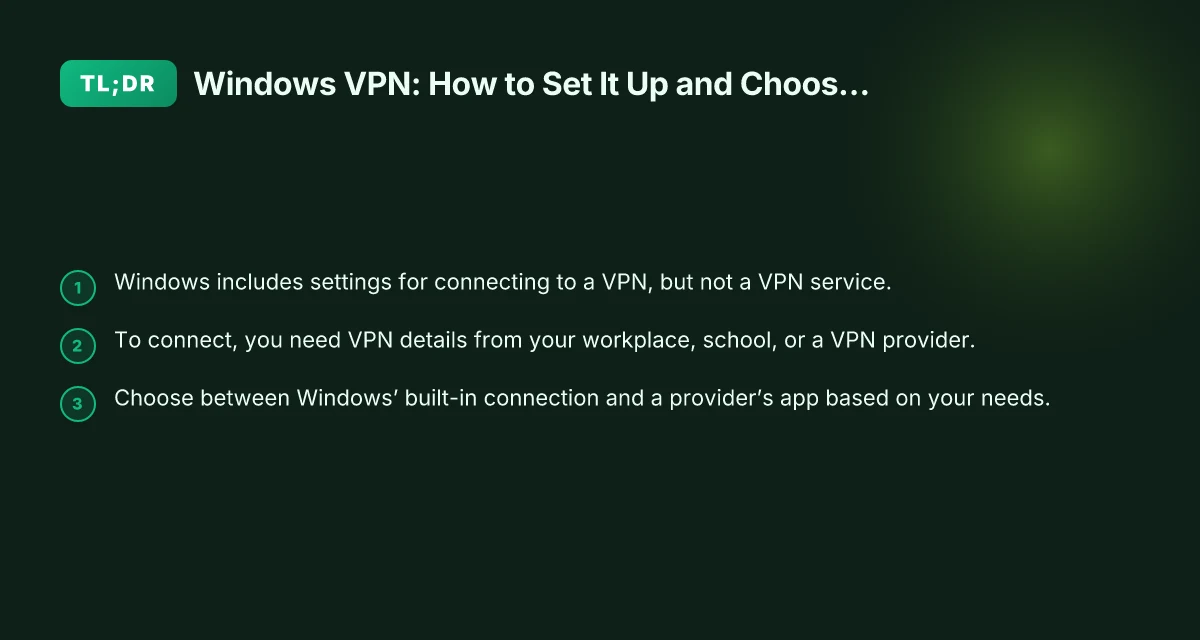
A Windows VPN connection can protect traffic between your PC and a VPN server, but Windows does not provide the VPN service itself. You need a VPN account or organization-provided connection details first. Then you can connect through Windows settings or, for many commercial services, install the provider’s Windows app.
Editor's pick: NordVPN — fast, secure VPN — Strong encryption, a no-logs policy and apps for every device. 30-day money-back guarantee. Get NordVPN →
Compare Windows VPN connection options
| Option | What you need | Setup location | Best for | Key limitation |
|---|---|---|---|---|
| Windows built-in VPN | VPN server details | Settings | Connecting to a compatible work or personal VPN | Does not provide a VPN service |
| VPN provider’s Windows app | VPN subscription or account | Provider’s app | Straightforward setup and server selection | Features vary by provider |
| Work or school VPN | Organization’s instructions | Settings or organization’s app | Accessing private work or school resources | Requires organization-provided access |
| Manual VPN profile | Server address and connection details | Settings | Configuring a compatible VPN without its app | Details must be entered correctly |
| Browser proxy or extension | Compatible browser tool | Browser | Changing traffic routing in that browser | Does not cover all Windows traffic |
| No VPN | None | Not applicable | Using the internet without a VPN connection | No VPN tunnel for network traffic |
Compiled November 2026; check the provider's site for current details.
| VPN | Obfuscation | From / month | Plan | Free plan | Refund | Alipay | UnionPay | Crypto | Website opens in China | Trustpilot | |
|---|---|---|---|---|---|---|---|---|---|---|---|
 ZoogVPN | Turn on manually Shadow | $2.49/mo | 27 months: $59.99 | Yes | 7 days | ✓ | ✓ | ✓ | ✓ | Official site blocked; our special link opens (4.4 s) | 4.2/5 (195 reviews) |
 NordVPN | Turn on manually Obfuscated Servers / NordWhisper | $3.49/mo | 27 months: $94.23 | No | 30 days | ? | ✗ | ✓ | ✓ | ✗ Blocked | 4.2/5 (51,628 reviews) |
 ExpressVPN | ✓ On by default all servers | $3.00/mo | 28 months: $84 | No | 30 days | ✗ | ✗ | ✓ | ✗ | ✗ Blocked | 4.4/5 (29,706 reviews) |
 Surfshark | ✓ On by default Camouflage, with OpenVPN | See site | See site | No | 30 days | ✗ | ✗ | ✗ | ✓ | ✗ Blocked | 4.3/5 (31,823 reviews) |
 Proton VPN | Turn on manually Stealth, free plan too | $2.99/mo | 12 months: $35.88 | Yes | 30 days | ✗ | ✗ | ✗ | ✓ | ✗ Blocked | 2.1/5 (1,040 reviews) |
 Astrill VPN | Turn on manually StealthVPN / OpenWeb | $12.50/mo | 24 months: $300 | No | See site | ✗ | ✗ | ✗ | ✓ | ✗ Blocked | 1.3/5 (110 reviews) |
 Private Internet Access | Turn on manually Shadowsocks, OpenVPN only | $2.03/mo | 40 months: $81.2 | No | 30 days | ✗ | ✗ | ✗ | ✗ | ✗ Blocked | 4.2/5 (11,033 reviews) |
 CyberGhost | Turn on manually selected servers | $2.19/mo | 28 months: $61.32 | No | 45 days | ✗ | ✗ | ✗ | ✓ | ✗ Blocked | 4.0/5 (24,178 reviews) |
 PureVPN | Turn on manually switch to OpenVPN | $1.69/mo | 60 months: $101.55 | No | 31 days | ? | ? | ✗ | ✓ | ✗ Blocked | 4.4/5 (17,994 reviews) |
 AdGuard VPN | ✓ On by default TrustTunnel | $2.99/mo | 24 months: $71.76 | Yes | 30 days | ✓ | ✗ | ✓ | ✓ | Official site blocked; our special link opens (3.7 s) | 4.3/5 (290 reviews) |
 Mullvad | Turn on manually QUIC / Shadowsocks / LWO | $5.61/mo | €5/mo | No | 14 days | ✗ | ✗ | ✗ | ✓ | ✗ Blocked | 3.2/5 (192 reviews) |
 Windscribe | Turn on manually Stealth / WStunnel | $5.75/mo | 12 months: $69 | Yes | See site | ✗ | ✗ | ✗ | ✓ | ✗ Blocked | 4.7/5 (13,355 reviews) |
 StrongVPN | Turn on manually Scramble, OpenVPN TCP | See site | See site | No | 30 days | ✓ | ✗ | ✗ | ✗ | ✗ Blocked | 4.4/5 (2,695 reviews) |
 LightXtreme 闪连 | Not listed | $7.08/mo | 12 months: $84.99 | Yes | 30 days | ✓ | ✓ | ✓ | ✓ | ✓ Yes (3.5 s) | No page |
Prices checked 2026-11-10 on each vendor's pricing page (cheapest long plan, USD). Check the vendor's checkout for the final price.
Obfuscation checked 2026-11-14 on each vendor's site and help center: "on by default" = nothing to set; "turn on manually" = switch protocol or mode in settings; "not listed" = the vendor describes no obfuscation.
Payment methods checked 2026-11-10 on each vendor's payment pages: all 14 take cards and PayPal; ✗ = not listed, ? = the vendor's own pages disagree.
China access: whether the official website opens from mainland China networks (tests the website only, not the VPN connection). Last checked 2026-11-18 01:02 Beijing time.
Trustpilot score and review count checked 2026-11-10.
Does Windows have a built-in VPN?
Windows includes a VPN setup interface. It lets you enter connection details and manage a connection, but it does not supply a VPN server, subscription, or account. In other words, seeing VPN in Settings does not mean your computer is already connected to a VPN.
You can get connection details from:
- Your employer or school, if it provides remote access
- A VPN service you have chosen
- A network administrator who manages the VPN
Those details may include a server address, connection type, and sign-in information. The required information depends on the VPN service or organization.
How to connect to a VPN in Windows
Microsoft’s instructions use the Settings app. The exact labels can vary slightly by Windows version, but the general process is: Free VPN for Microsoft Edge: What Works and What to Know
- Open Settings.
- Select Network & internet, then VPN.
- Choose Add VPN or Add a VPN connection.
- Enter the connection information supplied by your organization or VPN provider.
- Save the connection.
- Return to the VPN page, select the connection, and choose Connect.
If you use a workplace or school VPN, contact its IT team if you do not know what to enter. Avoid guessing the server address or connection type: incorrect settings can prevent a connection or send you to an untrusted service.
To disconnect, return to the VPN page in Settings, select the active connection, and choose Disconnect.
Windows settings or a VPN app?
Many VPN providers offer their own Windows apps. These apps typically handle setup and offer controls specific to that service. The built-in Windows connection, by contrast, is a way to configure a compatible VPN using details you already have.
| Option | Best suited to | What you need |
|---|---|---|
| Windows VPN settings | Work, school, or a service with setup details | Server and connection information, plus sign-in credentials |
| Provider’s Windows app | People who want the provider’s own interface and features | An account or access with that provider |
| No VPN connection | Everyday browsing when a VPN is not needed | No VPN setup |
Use the option your organization or VPN provider recommends. Some services support Windows’ built-in connection, while others direct users to their own app. Check the provider’s instructions before setting up a manual connection. Edge Secure Network VPN Review: What It Protects, and What It Doesn’t
Choose the right VPN setup for your needs
| Need | Windows settings | Provider app | Work or school setup | No VPN |
|---|---|---|---|---|
| Connect to a personal VPN provider | Supported with compatible details | Supported | Not intended for this use | Not applicable |
| Connect to an organization’s VPN | Supported if configured | Supported if provided | Often the intended option | Not applicable |
| Choose a VPN server | Depends on the profile | Usually available | Organization controls access | Not applicable |
| Use provider-specific features | No | Depends on the provider | Depends on the organization | No |
| Manage connection in one place | Windows Settings | Provider’s app | Settings or organization’s app | Not applicable |
| Set up without server details | No | Usually supported through sign-in | Requires organization instructions | Yes |
| Protect traffic beyond a browser | Supported when connected | Supported when connected | Supported when connected | No |
Compiled November 2026; check the provider's site for current details.
What does a VPN do, and what doesn’t it do?
A VPN creates an encrypted connection between your device and a VPN server. This can help protect data in transit, particularly when you use networks you do not control, and it can make your internet traffic appear to come from the VPN server’s location.
A VPN does not make you completely anonymous or protect against every online risk. Websites can still identify you through account sign-ins, cookies, and other tracking methods. A VPN also does not replace updates, strong passwords, or careful handling of suspicious links and downloads. FortiClient VPN Windows 11: Setup, Connection Steps, and Fixes
When you use a commercial VPN, your provider becomes an important part of the trust relationship. Review its privacy information and understand what service you are connecting to. For workplace or school access, follow the organization’s security guidance.
How to choose a Windows VPN
Before installing an app or entering connection details, consider what you need the VPN for.
- Remote access: If you need to reach work or school resources, use the VPN supplied by that organization.
- Personal privacy: Compare providers’ privacy practices, supported Windows features, and setup instructions.
- Ease of use: A provider’s app may be simpler if it supports your service and offers the controls you need.
- Compatibility: Confirm that the service supports your version of Windows and the connection method it requires.
- Cost and limits: Check the provider’s current plan terms and any restrictions before signing up.
Be cautious with unfamiliar free VPN offers. “Free” does not, by itself, explain how a service handles your data, what features it provides, or whether its software is trustworthy. Read the provider’s terms and privacy policy rather than choosing based on a claim alone.
Troubleshooting a Windows VPN connection
If the connection fails, first confirm that your internet connection works without the VPN. Then check the details you entered against the instructions from your provider or IT team. VPN for Edge: How to Choose and Use One Safely
Try these steps:
- Recheck the server address, connection type, and username or password.
- Confirm that your account is active and allowed to connect.
- Follow any required setup steps from your organization or provider.
- Restart the VPN app or reconnect through Settings.
- Ask your network administrator or provider for help if the error continues.
Do not share your password or verification codes with someone who contacts you unexpectedly. A legitimate support team should provide a secure way to resolve account or connection issues.
Match VPN problems to first checks
| Problem | Check first | Likely next step | Where to look |
|---|---|---|---|
| VPN will not connect | Internet connection | Retry the connection | Windows or VPN app |
| Sign-in fails | Username and password | Confirm account access | Provider or organization |
| Server is unreachable | Server address and availability | Try a supported server | VPN settings or app |
| Connection drops | Network stability | Reconnect or try another network | Windows or VPN app |
| Work resources stay unavailable | Work VPN connection | Follow organization instructions | IT support |
| VPN connects but traffic is not protected | VPN status and settings | Confirm the tunnel is active | Windows or VPN app |
| Built-in VPN setup fails | Connection details and VPN type | Check provider’s configuration instructions | Windows Settings |
Compiled November 2026; check the provider's site for current details. Chrome Urban VPN: How to Install It, Use It, and Assess Its Safety
Recommendation
For workplace or school access, use the connection details and setup method provided by IT. For a personal VPN, choose a provider you trust and follow its Windows instructions. Use the built-in VPN settings only if the service supports that configuration. Windows gives you a place to connect, but the VPN service itself comes from elsewhere.
Zeynep VPN hizmetlerini test eder.