iPhone VPN: How to Choose, Set Up, and Use One
Learn what an iPhone VPN does, how to set one up, and when it can help protect your privacy.
An iPhone VPN is a service or work connection that routes your internet traffic through a VPN server. It can help protect traffic on networks you do not trust and may help you access services when traveling. An iPhone has settings for connecting to a VPN, but it does not come with a built-in consumer VPN service. To use one, install a provider’s app or configure a connection using details supplied by your workplace or VPN provider.
Editor's pick: NordVPN — fast, secure VPN — Strong encryption, a no-logs policy and apps for every device. 30-day money-back guarantee. Get NordVPN →
Compare common ways to use a VPN on iPhone
| Option | Setup method | Ongoing management | Best suited for | Main consideration |
|---|---|---|---|---|
| VPN provider app | Install the app and sign in | Manage in the app | Most iPhone users | Choose a provider you trust |
| Manual VPN configuration | Enter connection details in Settings | Manage in Settings | Users with provider details | Requires configuration information |
| VPN profile | Install a profile from a provider or organization | Check profile settings | Managed or work devices | Trust the profile source |
| On-demand connection | Configure VPN to connect under set conditions | Automatic after setup | Users who want automatic coverage | Availability depends on configuration |
| Always-on VPN | Keep the connection active when enabled | Monitor connection status | Users seeking continuous VPN use | Can affect battery or connectivity |
| VPN with public Wi-Fi | Connect before using the network | Reconnect if the VPN drops | Travel and public hotspots | A VPN does not make every activity private |
| VPN with mobile data | Connect over cellular | Use the provider app or settings | Everyday browsing | May affect speed or data use |
Compiled November 2026; check the provider's site for current details.
| VPN | Obfuscation | From / month | Plan | Free plan | Refund | Alipay | UnionPay | Crypto | Website opens in China | Trustpilot | |
|---|---|---|---|---|---|---|---|---|---|---|---|
 Proton VPN | Turn on manually Stealth, free plan too | $2.99/mo | 12 months: $35.88 | Yes | 30 days | ✗ | ✗ | ✗ | ✓ | ✗ Blocked | 2.1/5 (1,040 reviews) |
 ZoogVPN | Turn on manually Shadow | $2.49/mo | 27 months: $59.99 | Yes | 7 days | ✓ | ✓ | ✓ | ✓ | Official site blocked; our special link opens (4.4 s) | 4.2/5 (195 reviews) |
 NordVPN | Turn on manually Obfuscated Servers / NordWhisper | $3.49/mo | 27 months: $94.23 | No | 30 days | ? | ✗ | ✓ | ✓ | ✗ Blocked | 4.2/5 (51,628 reviews) |
 ExpressVPN | ✓ On by default all servers | $3.00/mo | 28 months: $84 | No | 30 days | ✗ | ✗ | ✓ | ✗ | ✗ Blocked | 4.4/5 (29,706 reviews) |
 Surfshark | ✓ On by default Camouflage, with OpenVPN | See site | See site | No | 30 days | ✗ | ✗ | ✗ | ✓ | ✗ Blocked | 4.3/5 (31,823 reviews) |
 Astrill VPN | Turn on manually StealthVPN / OpenWeb | $12.50/mo | 24 months: $300 | No | See site | ✗ | ✗ | ✗ | ✓ | ✗ Blocked | 1.3/5 (110 reviews) |
 Private Internet Access | Turn on manually Shadowsocks, OpenVPN only | $2.03/mo | 40 months: $81.2 | No | 30 days | ✗ | ✗ | ✗ | ✗ | ✗ Blocked | 4.2/5 (11,033 reviews) |
 CyberGhost | Turn on manually selected servers | $2.19/mo | 28 months: $61.32 | No | 45 days | ✗ | ✗ | ✗ | ✓ | ✗ Blocked | 4.0/5 (24,178 reviews) |
 PureVPN | Turn on manually switch to OpenVPN | $1.69/mo | 60 months: $101.55 | No | 31 days | ? | ? | ✗ | ✓ | ✗ Blocked | 4.4/5 (17,994 reviews) |
 AdGuard VPN | ✓ On by default TrustTunnel | $2.99/mo | 24 months: $71.76 | Yes | 30 days | ✓ | ✗ | ✓ | ✓ | Official site blocked; our special link opens (3.7 s) | 4.3/5 (290 reviews) |
 Mullvad | Turn on manually QUIC / Shadowsocks / LWO | $5.61/mo | €5/mo | No | 14 days | ✗ | ✗ | ✗ | ✓ | ✗ Blocked | 3.2/5 (192 reviews) |
 Windscribe | Turn on manually Stealth / WStunnel | $5.75/mo | 12 months: $69 | Yes | See site | ✗ | ✗ | ✗ | ✓ | ✗ Blocked | 4.7/5 (13,355 reviews) |
 StrongVPN | Turn on manually Scramble, OpenVPN TCP | See site | See site | No | 30 days | ✓ | ✗ | ✗ | ✗ | ✗ Blocked | 4.4/5 (2,695 reviews) |
 LightXtreme 闪连 | Not listed | $7.08/mo | 12 months: $84.99 | Yes | 30 days | ✓ | ✓ | ✓ | ✓ | ✓ Yes (3.5 s) | No page |
Prices checked 2026-11-10 on each vendor's pricing page (cheapest long plan, USD). Check the vendor's checkout for the final price.
Obfuscation checked 2026-11-14 on each vendor's site and help center: "on by default" = nothing to set; "turn on manually" = switch protocol or mode in settings; "not listed" = the vendor describes no obfuscation.
Payment methods checked 2026-11-10 on each vendor's payment pages: all 14 take cards and PayPal; ✗ = not listed, ? = the vendor's own pages disagree.
China access: whether the official website opens from mainland China networks (tests the website only, not the VPN connection). Last checked 2026-11-18 01:02 Beijing time.
Trustpilot score and review count checked 2026-11-10.
What a VPN does on an iPhone
When your VPN is connected, traffic from your iPhone travels through an encrypted tunnel to a VPN server before reaching its destination. This can make it harder for people on the same public Wi-Fi network to inspect your traffic. Websites and apps will generally see the VPN server’s IP address rather than your usual network address.
A VPN does not protect everything. It does not guarantee anonymity, prevent every form of tracking, or replace safe browsing habits. Websites may still identify you through account sign-ins, cookies, or other information. A VPN provider may also be able to see some connection data, so its privacy practices matter.
iPhone VPN basics
| Option | What it is | Best suited to |
|---|---|---|
| VPN provider app | An app that connects to the provider’s VPN servers | Personal privacy and travel |
| Manual VPN setup | A connection configured in iPhone settings using supplied details | Users whose provider or organization gives setup instructions |
| Work VPN | A connection managed or specified by an employer | Accessing workplace systems |
Apple supports VPN configuration for device deployment, including VPN On Demand, which can automatically establish a connection when needed. That is a configuration capability, not a free personal VPN subscription.
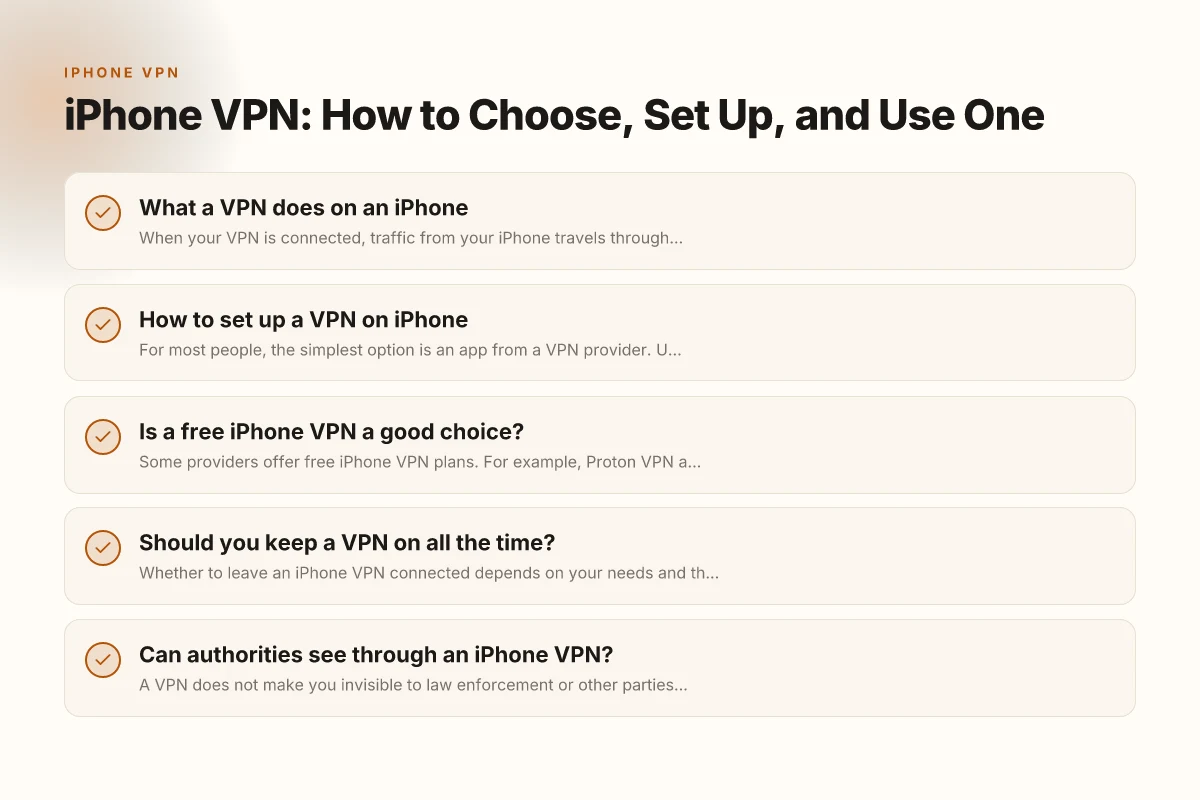
How to set up a VPN on iPhone
For most people, the simplest option is an app from a VPN provider. Use the provider’s official instructions, because app screens and setup steps can differ. Forti VPN: What FortiClient VPN Does and How to Use It
- Choose a VPN provider and review its privacy policy, security information, and service limits.
- Download its official app from the App Store.
- Open the app, sign in or create an account, and follow its setup prompts.
- When iOS asks for permission to add VPN configurations, review the request and approve it only if you trust the provider.
- Connect in the app and confirm the VPN indicator appears on your iPhone.
You can also check or manage available VPN configurations in Settings. The exact menu wording can vary by iOS version and configuration. If you are setting up a workplace VPN, ask your IT team for the correct server address, account details, and connection type rather than guessing.
To disconnect, open the VPN app and tap its disconnect control, or use the iPhone’s VPN controls if they are available. If the VPN will not connect, check your internet connection, update the app, and consult the provider’s troubleshooting instructions.
Decide whether a free or paid iPhone VPN fits your needs
| Factor | Free VPN | Paid VPN | What to check |
|---|---|---|---|
| Cost | No subscription fee | Usually requires payment | Price and renewal terms |
| Data allowance | May be limited | Often offers higher limits | Monthly cap |
| Server choice | May be limited | Often offers more locations | Available countries |
| Speed | May vary | May offer more consistent access | Performance in your area |
| Privacy terms | Vary by provider | Vary by provider | Logging and data-use policy |
| Ads | May include ads | Often fewer or none | App experience |
| Support | May be limited | May include more support | Help options |
| Best fit | Light, occasional use | Regular use or more choice | Your needs and provider trust |
Compiled November 2026; check the provider's site for current details. F5 VPN Download: How to Get the Right Client and Connect
Is a free iPhone VPN a good choice?
Some providers offer free iPhone VPN plans. For example, Proton VPN advertises a free app for iPhone and iPad with no data limits. Features, server access, and usage terms can differ between free and paid plans and may change over time.
“Free” does not automatically mean unsafe, but it is worth checking how the service is funded and what information it collects. Be cautious with unfamiliar apps that make sweeping privacy promises or require permissions unrelated to VPN use.
Before choosing a free or paid service, look for:
- A clear privacy policy that explains what data is collected and retained.
- A trustworthy provider with identifiable support and security information.
- Strong account protections, such as multi-factor authentication where available.
- Clear limits on locations, speed, devices, or other features.
- An app that is regularly maintained and distributed through an official source.
Do not assume that a free plan offers every feature of a paid plan. Compare the current terms directly with the provider before installing or subscribing. Free VPN to Change Location: What to Know Before You Connect
Should you keep a VPN on all the time?
Whether to leave an iPhone VPN connected depends on your needs and the provider’s reliability. Keeping it on may provide consistent protection while you browse, especially on networks you do not control. However, some apps or websites may behave differently, and a VPN can affect connection speed or access to location-specific services.
A practical approach is to use the VPN when you want its protection or need to connect through a particular location, then disconnect if it causes a problem. If you use a work VPN, follow your organization’s instructions. Apple’s VPN On Demand feature can be configured by an organization or VPN setup to connect automatically in specified situations.
Remember that a VPN is only one part of online security. Keep iOS and your apps updated, use strong unique passwords, enable available account security features, and avoid suspicious links and downloads.
Choose a VPN setup based on your situation NordVPN Download Windows 11: How to Get Started
| Situation | Practical choice | Connection approach | Possible drawback | Check before use |
|---|---|---|---|---|
| Public Wi-Fi | Reputable VPN app | Connect before browsing | Connection may slow | Confirm the VPN is active |
| Everyday browsing | Provider app or manual setup | Connect when needed | May use extra battery | Review provider privacy terms |
| Frequent travel | VPN with suitable server locations | Select a nearby or needed location | Some services may restrict VPN traffic | Check destination availability |
| Work or school device | Organization-approved VPN | Follow administrator instructions | Settings may be managed | Confirm with IT |
| Occasional use | Free VPN, if trustworthy | Use within its limits | Data or server limits | Read privacy and logging terms |
| Continuous protection | VPN with automatic connection options | Enable supported automation | May affect connectivity or battery | Test how it behaves on your iPhone |
| Sensitive activity | Trusted VPN plus careful account security | Keep the connection active | A VPN cannot prevent all tracking | Use secure sites and strong authentication |
| Concern about authorities | Understand the provider and local rules | Use a VPN only as one privacy layer | A VPN does not guarantee anonymity | Review provider records and applicable law |
Compiled November 2026; check the provider's site for current details.
Can authorities see through an iPhone VPN?
A VPN does not make you invisible to law enforcement or other parties with lawful access to information. A VPN changes the route your traffic takes and encrypts the connection between your iPhone and the VPN server, but it cannot prevent every kind of monitoring or identify every person who accesses a service.
The websites and apps you use may still collect information about your activity. Your VPN provider may also retain or be required to provide information depending on its policies and applicable legal processes. A VPN should be treated as a privacy tool, not a guarantee that no one can trace activity.
Recommendation
For everyday personal use, choose a reputable VPN provider, install its official iPhone app, and read its privacy policy before connecting. Use the VPN when you want an encrypted connection through the provider, particularly on unfamiliar networks, while remembering that it does not replace other security measures. For work access, use the VPN configuration and guidance supplied by your employer. Checkpoint VPN: What It Does and How to Choose a Client
Aleks gizlilik araçları hakkında yazar.